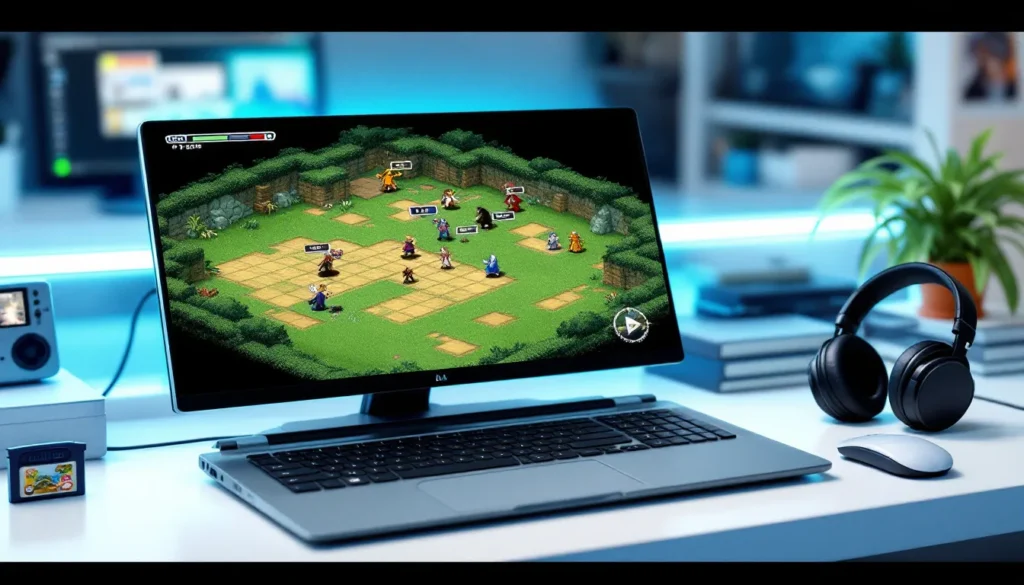
Final Fantasy Tactics Advance holds a special place in the tactical RPG pantheon. Released for the Game Boy Advance in 2003 (2004 in North America), this spin-off delivered deep strategic gameplay, job systems, and charming sprite work that still resonates with players decades later. If you’re hunting down a Final Fantasy Tactics Advance ROM to revisit this classic, or experience it for the first time, you’ve probably noticed the emulation scene has exploded with options, and the legality questions get murky fast. This guide cuts through the noise. We’ll explain what ROM files actually are, walk through the emulation landscape in 2026, address the elephant in the room (copyright), and most importantly, show you how to actually play this gem and master its systems.
Table of Contents
ToggleKey Takeaways
- Final Fantasy Tactics Advance ROM emulation requires understanding how ROM files work with emulators like Mgba or VBA-M to play this tactical RPG classic on modern devices.
- The Law System is FFTA’s defining mechanic—floating battle restrictions force strategic adaptation and creativity rather than simple brute-force combat.
- Downloading ROMs without owning the original game is legally risky, though owning physical cartridges and dumping your own ROMs offers more legal protection under fair use.
- FFTA’s 24-job system across multiple races offers surprising depth, with character flexibility and positioning-based tactics being more valuable than leveling a single class.
- The game remains brutally replayable with multiple story branches, post-game challenges, and timeless tactical design that influenced modern RPGs like Fire Emblem and Disgaea.
- Official alternatives to ROM emulation include purchasing original hardware ($80–150 for a GBA), waiting for potential Nintendo Switch Online Game Boy Advance support, or hunting for future re-releases.
What Is Final Fantasy Tactics Advance?
Final Fantasy Tactics Advance is a tactical role-playing game (TRPG) developed by Kasa and published by Square Enix. Unlike the mainline Final Fantasy games, FFTA eschews real-time action in favor of grid-based tactical combat. You command a squad of units on isometric maps, each with unique abilities, jobs, and skill trees. The story follows Marche Radiates, a young man who discovers a mysterious book that transforms his world into Ivalice, a magical realm straight out of classic Final Fantasy lore.
What made FFTA special was its accessibility combined with surprising depth. The game never assumed you’d played the original Final Fantasy Tactics on PlayStation. The tutorial eases you in, but once you’re rolling, the job system becomes genuinely complex. You’ve got 24 different jobs across multiple races (Humans, Moogles, Bangaa, Nu Mou), each with branching ability trees. The Law System adds another layer: during battles, floating laws can restrict certain actions, forcing adaptation and creativity.
The GBA’s technical limitations never held the game back. The sprite work is gorgeous. Combat animations crackle with personality. The soundtrack, composed by Hitoshi Sakimoto, remains phenomenal, tracks like “”Marche in Time”” and the Duelhorn battle theme stick with you. FFTA sold over 2 million copies and spawned a spiritual successor on DS: Final Fantasy Tactics A2. But the original Advance still stands as one of the finest tactical RPGs on portable hardware.
Understanding ROM Files and Emulation
What Exactly Is a ROM File?
A ROM file is a byte-for-byte digital copy of a game cartridge’s contents. ROM stands for “Read-Only Memory”, it’s literally what was burned onto the physical chips inside your Game Boy Advance cartridge. When you have a FFTA ROM file on your computer, you’re holding a complete, unmodified snapshot of the game.
ROM files are raw data. On their own, they do nothing. Your PC can’t just double-click a ROM and launch the game. That’s where emulators come in.
How Emulation Works for Retro Games
An emulator is software that mimics the hardware of the original console. In this case, we’re talking about the Game Boy Advance, specifically its ARM processor, graphics hardware, and memory architecture. A good emulator replicates these components so accurately that a ROM file runs nearly identically to how it would on original hardware.
When you load your FFTA ROM into an emulator, here’s what happens: The emulator reads the ROM file, interprets the ARM machine code, renders graphics through your monitor, outputs audio through your speakers, and maps your controller inputs to GBA button presses. All of this happens in real-time.
The quality of emulation varies. Early emulators were rough approximations. Modern emulators like Mgba and VBA-M (covered below) achieve cycle-accurate or near-cycle-accurate emulation, meaning they replicate the GBA’s behavior so closely that even games with finicky timing work flawlessly. Some emulators go further, adding upscaling filters, save state functionality, and controller customization that the original hardware never had.
Emulation is technically CPU-intensive. Your PC is essentially playing the role of a Game Boy Advance. But the GBA’s 32-bit ARM processor from 2001 is child’s play for modern machines. Even a mid-range laptop runs FFTA at full speed without breaking a sweat.
Legal and Ethical Considerations for ROM Emulation
Copyright Laws and ROM Ownership
Let’s be blunt: distributing or downloading copyrighted ROMs without permission is legally gray at best, illegal in most jurisdictions at worst. Square Enix owns the intellectual property to Final Fantasy Tactics Advance. They own the code, the art, the music, all of it.
Here’s the nuance that matters: Owning a ROM of a game you legally purchased is more defensible than downloading one you never bought. If you own a physical copy of FFTA, dumping your own ROM from your cartridge via a device like the Retrode is legal in many countries under fair use provisions. But downloading a ROM someone else dumped? That crosses into copyright infringement in most US and EU jurisdictions.
Don’t expect Square Enix to give you a wink and a nod here. Major publishers actively defend their IP. That said, enforcement is inconsistent, they’re more likely to pursue large distribution sites than individual players. But “they probably won’t catch me” isn’t a solid legal defense.
The practical reality: the emulation community operates in legal limbo. Many players do it anyway, fully aware of the risks. Others don’t. Both perspectives are valid.
Official Alternatives to ROM Emulation
If you want to play FFTA cleanly, legal options exist:
- Game Boy Advance cartridge + original hardware: Used GBA systems and cartridges are readily available online. Expect to pay $80–150 for a working GBA SP and another $30–60 for a cartridge. It’s not cheap, but it’s the purest way to play.
- Nintendo Switch Online + Expansion Pack: This is the golden ticket. Nintendo has hinted at Game Boy Advance emulation coming to NSO, though official confirmation is sparse as of early 2026. When and if it arrives, FFTA would likely be included in the library.
- Re-releases and Collections: Square Enix hasn’t formally re-released FFTA on modern platforms, though there’s always hope for future compilations.
The reality is that FFTA isn’t available for digital purchase on modern storefronts. Square Enix hasn’t brought it to the Switch eShop, PlayStation Store, or Steam. That’s the core frustration: the game exists in a licensing limbo where the only “official” way to play is hunting down ancient hardware.
Popular Emulators for Final Fantasy Tactics Advance
Best Emulators by Platform
Mgba (Multi-system), This is the gold standard. Mgba is accurate, lightweight, and actively maintained. It supports Windows, Mac, and Linux. The development team prioritizes accuracy over speed, and it shows: games run perfectly. Save states, fast-forward, and rewind features are all built-in. No bloat, no ads, no nonsense. If you’re using a decent PC, this is the only emulator you need. Download it from mgba.io.
VBA-M (Windows/Mac), VBA-M is another solid option, though it’s less frequently updated than Mgba. It handles FFTA beautifully and offers similar features: savestates, turbo, controller support. It’s slightly older codebase but still reliable. Some prefer its interface: others prefer Mgba’s minimalism.
gPSP (Android), For mobile emulation, gPSP is a go-to. It brings GBA games to Android phones and tablets with impressive accuracy. Controls take adjustment (touch screens aren’t ideal for tactical games), but it works. Alternatively, John GBA is another Android option with a cleaner UI.
Dolphin (Windows/Mac/Linux), You might see Dolphin mentioned in emulation circles, but that’s for GameCube and Wii emulation, not GBA. Skip this for FFTA.
Performance and Compatibility Tips
Final Fantasy Tactics Advance is one of the most compatible games in the GBA library. It runs flawlessly on every major emulator. Here’s what you should know:
Graphics: The game uses Mode 0 backgrounds and sprite scaling, techniques that some emulators struggle with. Mgba and VBA-M handle them perfectly. If you see flickering or distorted tiles, you’ve likely hit a compatibility issue with an obscure emulator. Stick with the mainstream options.
Save files: The original cartridge uses SRAM (Static RAM) for saves. Modern emulators handle this transparently. Your savestates and game saves are stored as separate files on your PC. Don’t mix them up. Some emulators use .sav files for cartridge saves: others use .savestate formats. Check your emulator’s documentation.
Audio: FFTA’s soundtrack is completely intact in emulation. The GBA uses a simple sound chip, and modern emulators reproduce it faithfully. If you hear crackling, check your audio driver settings in the emulator itself, sometimes a simple refresh rate adjustment fixes it.
Display options: Modern emulators let you upscale the GBA’s 240×160 resolution. Integer scaling (2x, 3x, 4x) keeps the pixel art clean. Shader filters (like HQ2x) can smoothen edges but sometimes introduce artifacts. Experiment and find what your eyes prefer. On a 1080p monitor, 3x integer scaling looks crisp without distortion.
Essential Gameplay Tips and Beginner Strategies
Character Classes and Job System Explained
FFTA’s job system is where strategy is born. You start with basic jobs, Fighter, Thief, Black Mage, White Mage, but unlock 20+ more through combat and story progression. Each job has unique abilities tied to a branching skill tree.
Here’s the structure: Your characters gain Job Points (JP) whenever they use abilities in battle. Spend JP to unlock new abilities for that job. Once you’ve mastered enough abilities on a job, you can switch to a new job. The twist: switching jobs doesn’t reset your growth. If your Moogle was a Thief and you switch him to Dragoon, he keeps his Thief stats as a baseline.
Key jobs to prioritize early:
- Fighter (Human): Solid damage dealer. Ability Focus on physical attacks. Good starter class.
- Thief (Moogle): Speed is broken in FFTA. Thieves move first, act first, run circles around enemies. Steal items and skills mid-battle.
- Black Mage (Nu Mou): Elemental damage and status effects. Slow to act but devastating spellcasting.
- White Mage (Human/Nu Mou): Healing is essential. Get comfortable with buffs and cures early, your party will live longer.
- Dragoon (Bangaa): High physical damage with jump abilities. Excellent for mid-to-late game.
- Paladin (Human): Late-game tank. Defensive abilities and self-healing.
Race selection matters too. Humans are balanced, Moogles are fast and evasive, Bangaa are physical powerhouses, and Nu Mou are magical specialists. Your first party composition matters less than your flexibility. Don’t get locked into one archetype.
Combat Tactics and Law System Guide
FFTA’s Law System is its defining mechanic. Each battle has 1–3 floating laws that restrict certain actions. Break a law, and you get a red card (temporary action penalty). Get red-carded too many times, and a unit gets knocked out, permanently removed from the battle.
Laws feel restrictive at first. “No White Magic? How am I supposed to heal?” But here’s the kicker: laws force you to think differently. They’re not punishment: they’re puzzle pieces. A law banning ranged attacks forces you to close distance and fight melee. A law banning magic? Use physical abilities and items instead.
Combat positioning is critical. FFTA uses an isometric grid. Height matters, elevation matters, line-of-sight matters. Position a Thief on high ground, and she’s nearly untouchable. Funnel enemies through narrow corridors. Use the terrain.
Status effects are underrated. Slow, Stop, Blind, Silence, these turn the tide way more than raw damage. A Silenced enemy can’t cast magic. A Stopped enemy can’t act. Pour status effects onto priority targets.
Job diversity wins. Don’t field five Fighters. Mix jobs. A team of Thief, Black Mage, White Mage, Dragoon, and Paladin covers offense, magic, healing, burst damage, and defense. Flexibility is strength. When a law bans physical attacks, your mages shine. When magic is restricted, your fighters dominate.
Ability chains are real. Some abilities chain together. If you hit a target with Sleep, then follow with Snooze, the damage multiplier increases. Chaining abilities is advanced stuff, but once you see it click, your strategies deepen immensely.
Early game is forgiving, you can brute-force encounters. Mid-game is where law system wisdom pays dividends. Late-game battles demand it. If you’re struggling, it’s usually because you’re ignoring positioning or laws. Adapt, and you’ll dominate.
Common Issues and Troubleshooting
Saving and Loading Problems
The most common complaint: “My saves disappeared.”
Here’s usually what happened: You’re mixing save types. FFTA uses cartridge saves (stored in the emulated SRAM) and savestates (snapshots of the entire game state). These are different.
Cartridge saves are what you create when you stand on a Save Point and select “Save” in-game. These persist until you overwrite them. Savestates are backup snapshots you create outside of gameplay, they remember exactly where you were, which enemies were present, what your menu looked like.
If you’re using savestates exclusively and switch emulators or uninstall your emulator without backing up savestate files, they’re gone. Always maintain a backup of both cartridge saves and savestates to a separate folder.
Pro tip: Rename your savestate files. Instead of letting the emulator auto-number them (savestate_1, savestate_2), name them descriptively: “FFTA_Chapter3_BeforeBoss.state” or “FFTA_PostGame_VeryHardMode.state”. You’ll thank yourself later.
Another issue: Some emulators have corrupted SRAM files. If your game boots but refuses to load or save, the SRAM is trashed. Delete the .sram file associated with your ROM, launch the game, and let the emulator create a fresh one. You’ll lose unsaved progress, but the game will run again.
Graphics and Audio Glitches
Flickering sprites or missing tiles: This usually means your emulator’s graphics backend isn’t handling GBA’s rendering perfectly. Try switching between OpenGL and Direct3D (if your emulator supports it). On Mgba, go to settings > Video and toggle between backends.
Distorted or upscaled graphics: If you’re using shader filters and the game looks blurry or pixelated, try disabling them and using integer scaling instead (2x, 3x, 4x). Shaders like HQ2x can introduce artifacts with certain games. FFTA’s pixel art shines with clean integer upscaling.
Audio crackling or stuttering: This is usually a driver issue, not the emulator. Update your audio drivers. If that doesn’t work, reduce the emulator’s audio buffer size in settings. A lower buffer means less lag but risks crackling on slower systems. Find the sweet spot: usually 512–2048 samples.
Audio de-sync during cutscenes: Some emulators have minor audio-video sync issues during story sequences. This is annoying but not a dealbreaker. Turning off frame-skip or adjusting the refresh rate can help. Check online forums specific to your emulator for workarounds.
Black screen on launch: Your ROM file might be corrupted, or the emulator isn’t reading it correctly. Try a different ROM dump (if you have access). If that doesn’t help, reinstall the emulator. Corrupted downloads are rare but possible. If using Mgba, verify the ROM is a standard GBA dump (not a patched or modified version, unless that was intentional).
Most glitches are solved by updating your emulator to the latest version, updating your system drivers, and checking online forums specific to FFTA and your emulator. The community is active and helpful.
Why Play Final Fantasy Tactics Advance Today?
Two decades later, FFTA hasn’t aged. The tactical systems are intricate enough to reward dozens of hours of study. The story, about a boy escaping reality into a fantasy world, carries surprising emotional weight once you know where it’s heading.
If you’re into tactical RPGs, FFTA is essential listening. The level design teaches you positioning and space awareness in ways that modern grid-based tactics games still echo. The job system influenced everything from Disgaea to Fire Emblem. Playing FFTA isn’t just nostalgia: it’s understanding the DNA of a genre.
Beyond mechanics, FFTA has charm. The sprite animation, the synth-rock soundtrack by Hitoshi Sakimoto, the goofy dialogue, it’s a snapshot of early 2000s Square Enix, before production budgets spiraled and franchise bloat set in. There’s a purity to it.
FFTA is also brutally replayable. The story’s got multiple branches depending on your choices. The post-game dungeon (Rendezvous) is legitimately brutal. Competitive players have spent years optimizing loadouts and soloing high-level encounters. Nintendo Life offers robust reviews and retrospectives on classic Game Boy games like FFTA, often discussing their lasting appeal and how they hold up to modern standards.
For emulation specifically, FFTA’s near-perfect compatibility means you won’t battle technical issues. You’ll be playing the game, not troubleshooting the emulator. That’s invaluable for a classic this deep.
Conclusion
Final Fantasy Tactics Advance ROM emulation is accessible, affordable, and hassle-free from a technical standpoint. Whether you’re returning after two decades or discovering it for the first time, the game deserves the attention. The tactical depth, job system, and law mechanics remain singular even by modern standards.
The legal questions are yours to navigate. The options are clear: emulation exists, but so do original hardware and (potentially) future official re-releases. Wherever you land, the game itself hasn’t changed. It’s a masterpiece of the tactical RPG genre, and Ivalice is waiting.
Start with Mgba on Windows/Mac/Linux or gPSP on Android if you’re on mobile. Load your ROM. Build your squad. Learn the Law System. And prepare for one of the finest portable RPGs ever made. RPG Site maintains comprehensive guides and reviews for tactical games across platforms, making it a great resource for both newcomers and veterans exploring the genre’s rich history and mechanics.

